
Sex Offender Checks in New York County
The New York State Sex Offender Registry is managed by the Division of Criminal Justice Services, or DCJS. Its online directory displays Level 2 and Level 3 profiles that may lawfully be published. New York County does not supply a broader sheriff-run list or local radius map in the research sources. The state directory is therefore the main online source for Manhattan, with a DCJS phone search for Level 1 and not-yet-classified information.
Choose the channel by risk level and what is known. The online form can search by last name, New York County, or ZIP code. The phone line requires a name plus an exact address, date of birth, driver’s-license number, or Social Security number. For Level 1 or an unset level, released address information is limited to ZIP code. These rules mean a county or ZIP search online is not a complete list of every person subject to registration.
The official DCJS overview explains which New York risk levels appear online.
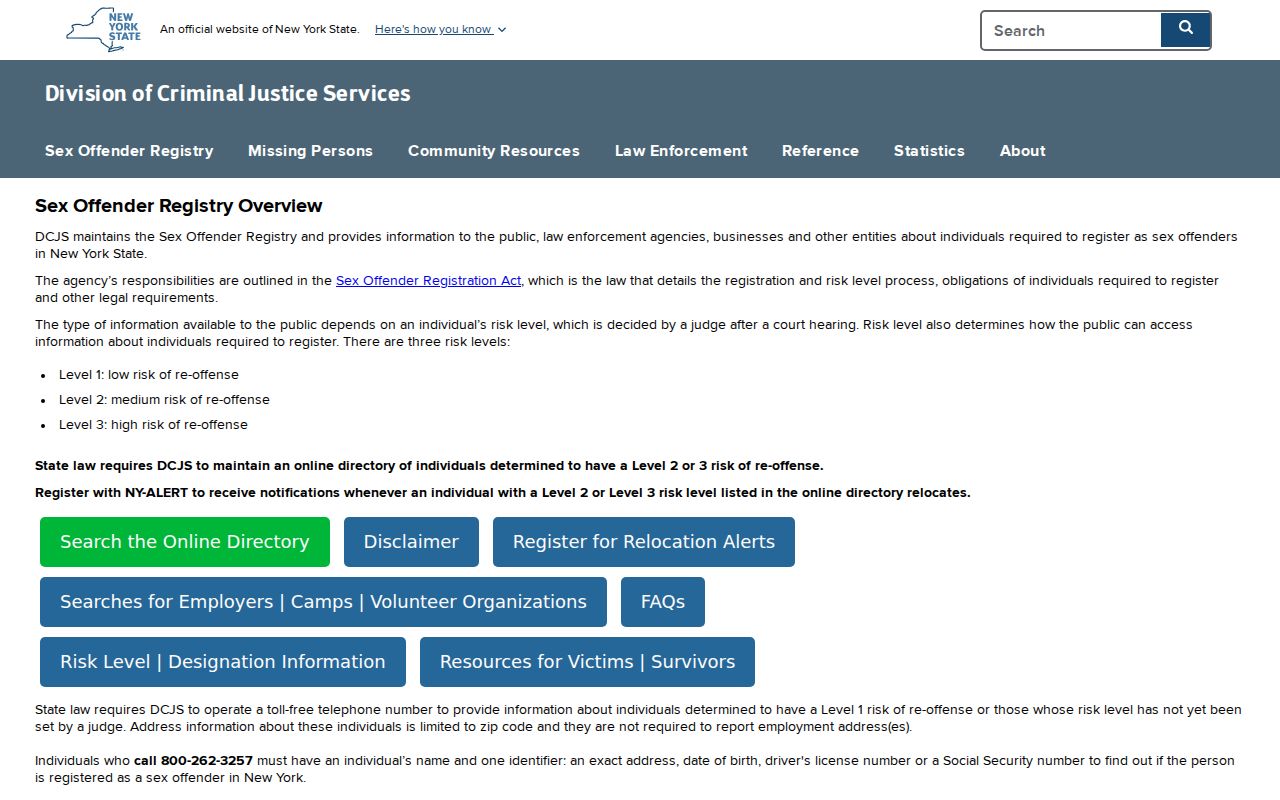
The overview supplies the rules needed to interpret a New York County result instead of assuming the online directory covers all risk levels.
New York County Registry Level Coverage
Online coverage begins at Level 2. Level 2 means medium risk and Level 3 means high risk under New York’s court-assigned system. Level 1 is the low-risk classification and is not placed in the public online directory. Someone who searches only the web can therefore miss information available by phone. A person whose risk level has not yet been set also uses the telephone route.
This is an unusual access split. The phone channel is broader by level, but it asks the caller for a strong matching fact. Call the public registry search line at 800-262-3257 with the name and one accepted identifier. For a Level 1 or unset record, expect only ZIP-level address information. The rule protects against treating the public registry as an unrestricted person locator while still allowing the disclosure set by New York law.
How to Search the New York State Sex Offender Registry
DCJS offers a narrow search form rather than a full map with a mileage radius. Start with one of the three supported search paths: last name, county, or ZIP code. For a New York County area search, choose New York in the county field. Custody filters can remove incarcerated entries, but excluding them changes the result set and should be a deliberate choice.
- Open the DCJS public directory and review its conditions and scope.
- Enter a last name, choose New York County, or enter a five-digit ZIP code. Do not combine unsupported map or radius assumptions with the form.
- Set any custody exclusions, complete the required captcha, and submit the search.
- Open a likely profile and compare name, aliases, photograph, physical details, address, conviction, and risk level before drawing a conclusion.
| Field Label | Type | Required | Options or Notes |
|---|---|---|---|
| Last Name | Text | One search path | Searches the directory by surname. |
| County | Dropdown | Alternative | Choose New York for Manhattan. |
| ZIP Code | Text | Alternative | Uses a five-digit area search. |
| Exclude Incarcerated | Checkbox | No | Removes local or state custody entries. |
| Exclude ICE Custody | Checkbox | No | Removes entries identified with ICE custody. |
| Exclude In Custody | Checkbox | No | Removes federal-prison-in-New-York entries. |
| Captcha | Checkbox | Yes | Must be completed before search. |
The DCJS directory interface displays these actual controls.
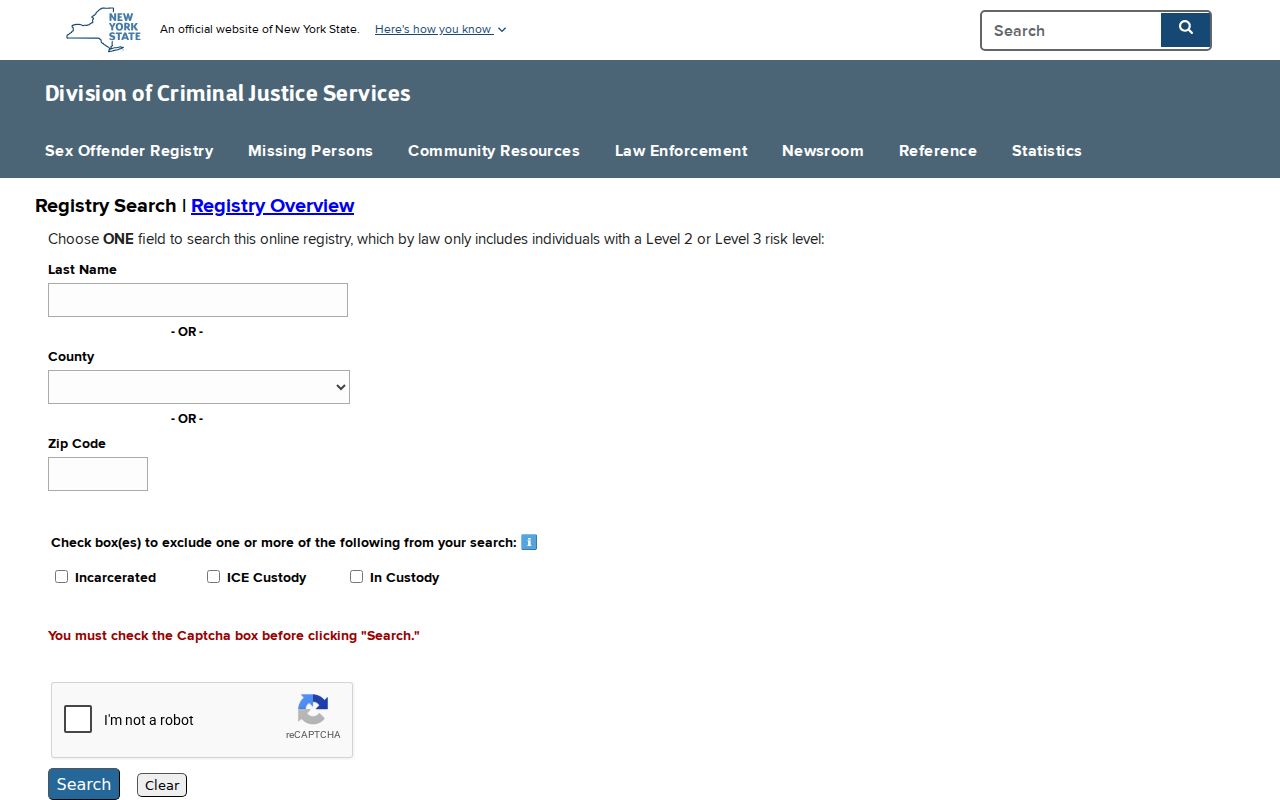
The form confirms that city, street, radius, map, risk-level, and sort controls are not part of the basic New York County directory search.
New York County Address Search Limits
A ZIP or county result is not a complete all-level map. The online directory includes qualifying Level 2 and Level 3 profiles, while Level 1 and not-yet-classified searches move to the telephone channel. The basic DCJS form does not provide one-, two-, or five-mile radius options. It also lacks a street-address box and a city filter. Searching New York County is useful for public online coverage, but it does not answer every question about a block or building.
Read an address with care. Registry information concerns the named person, not the whole home. A listed address does not show that another resident is registered. Location can also change, and identity may require matching aliases, age, physical details, and photographs. When safety depends on current facts, confirm the profile through DCJS and use the official contact channel rather than relying on a copied or old result.
Note: Selecting a custody exclusion can hide a listed person from the result even though the registration profile still exists.
Inside a Registry Profile
A public New York profile combines identity, conviction, risk, residence, and compliance fields. Availability depends on the assigned risk level, legal designations, and statutory or court limits. Multiple photographs may appear when available. Vehicle information can help distinguish a profile, but no one field should be used alone to identify someone in New York County.
| Name & Aliases | The registered name and known aliases released for the profile. |
|---|---|
| Photo & Physical Description | One or more available photographs, sex, race, date of birth or age, and physical traits. |
| Registered Address | Residence information at the level New York law allows for that classification. |
| Offense & Statute | The current or prior registerable conviction, jurisdiction, statute, and conviction or sentence details. |
| Level & Designation | The court-assigned risk level and any sexual predator, sexually violent, or predicate designation. |
| Registration Status | Registration and compliance information, plus supervision conditions when public. |
| Vehicle Information | Vehicle make, model, and license plate where available. |
A profile is a public-safety record, not a measure of every present circumstance. The listed conviction and level describe legal history and an assigned risk category. Verify the photograph and key identity facts before treating a result as a match.
New York County Registry Relocation Alerts
New York residents can register with NY-ALERT for notices tied to Level 2 and Level 3 individuals in the public directory. The alert workflow is separate from the main search form. It provides a way to learn of a listed move without repeatedly running the same New York County search. Alerts still inherit the directory’s level limits, so they do not replace the Level 1 telephone channel.
Use an alert as a prompt to open and verify the current DCJS profile. A notice may relate to a location or person, but the live official record supplies the current photo, address detail, conviction, and classification released by law. Do not forward an alert with added claims that the registry does not make. For urgent danger, call 911. Suspected registration noncompliance in Manhattan should go to local law enforcement through NYPD or 311 for a non-emergency.
New York Registration Levels and Requirements
A judge assigns New York’s risk level after a hearing. These levels are not the same as federal SORNA tiers. Numbered risk level, special designation, and registration duration are separate concepts. A sexual predator, sexually violent offender, or predicate designation carries lifetime registration regardless of the numbered level. Exact duties depend on the person’s case and statute.
| Classification | Public Channel | General Duration | Verification |
|---|---|---|---|
| Level 1 | Telephone, not online | Generally 20 years for post-2006 duty | Annual signed verification |
| Level 2 | Online and telephone | Generally life | Annual signed verification |
| Level 3 | Online and telephone | Generally life | Annual, plus in-person address verification every 90 days |
| Lifetime designation | Depends on level and release rules | Life | Duties depend on designation and level |
Annual signed verification must be returned within ten calendar days after receipt. Address, internet-identifier, and higher-education changes generally must be reported within ten days. Level 3 photographs update each year; Level 1 and Level 2 photographs update every three years. A Level 2 person without a lifetime designation may petition the relevant court after 30 years under Correction Law §168-o, but relief is not automatic.
New York County and NSOPW Results
The U.S. Department of Justice National Sex Offender Public Website, or NSOPW, adds a cross-state search layer. It can help when a person may have ties outside New York or when the county is uncertain. NSOPW searches information supplied by participating jurisdictions. It does not turn every state’s rules into one uniform national file.
For a Manhattan-only question, DCJS remains the primary New York source. For a broader geographic question, NSOPW can identify participating-state results that warrant review. Then return to the source jurisdiction’s official profile for its current details and release limits. A New York County no-result on NSOPW should not override the state telephone route for a New York Level 1 or not-yet-classified person.
The official NSOPW search shows how participating registries connect across state lines.
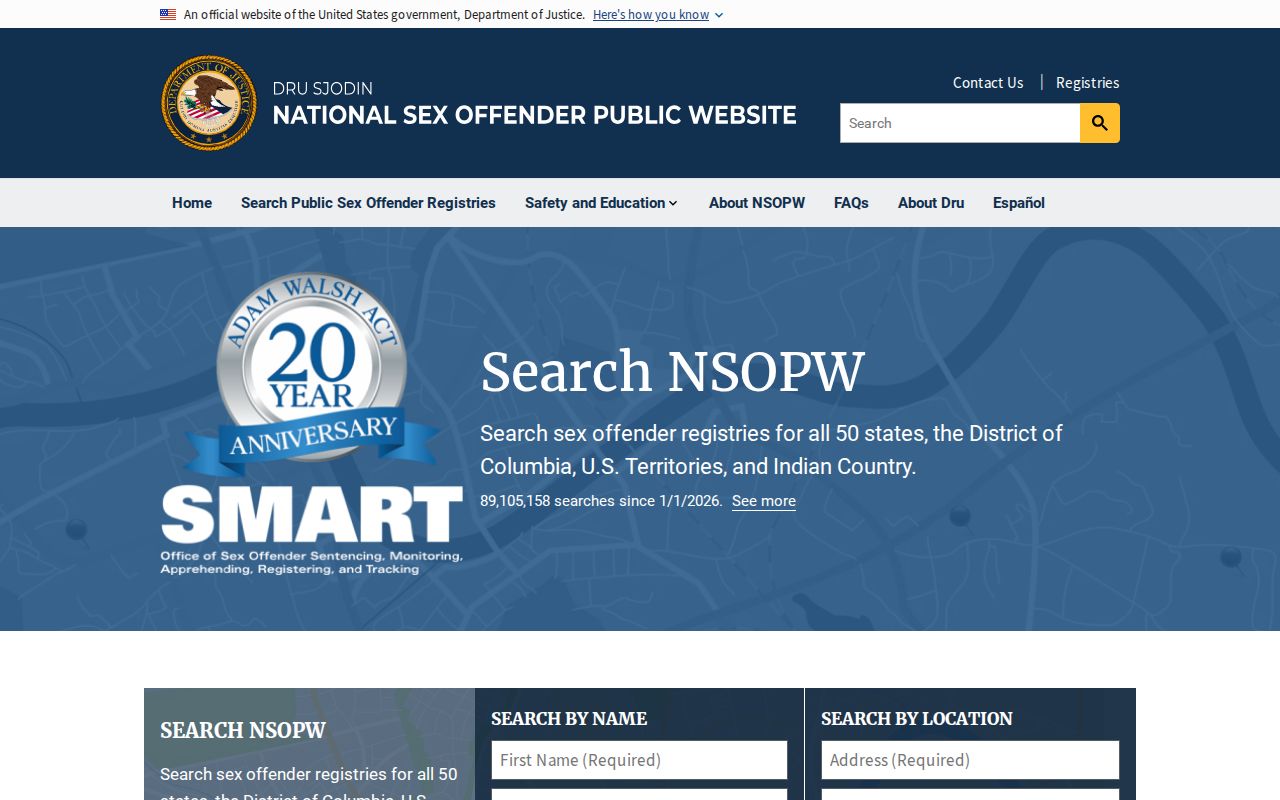
That national layer is useful for cross-state context, while DCJS controls the official New York County risk-level and disclosure details.
Report New York County Noncompliance
Suspected noncompliance belongs with law enforcement, not a personal confrontation. In New York County, call 911 for an emergency. Use 311 or NYPD for a non-emergency concern. Give a clear account of what was observed and identify the official profile involved, but do not claim that a person violated a duty merely because an old copied address differs from a current observation.
Questions about registry data can also go to DCJS. Registry staff are available at 518-417-3384 on weekdays from 8:00 a.m. to 4:00 p.m. The public risk-level search line is 800-262-3257. Written registry contact may be sent to SORRequests@dcjs.ny.gov or DCJS Sex Offender Registry, 80 South Swan Street, 10th Floor, Albany, NY 12210. These channels help separate a search question from a genuine compliance report.
Community Notification and Lawful Use
New York Correction Law Article 6-C governs registration, risk classification, and public release. Registry information is provided for public protection and community awareness. Use it to plan for personal and family safety, confirm an official notice, or better understand the information New York law makes public. Verify identity and address before relying on any match.
Public access does not authorize contact, pressure, punishment, or a threat. It also does not prove that another household member is registered. Keep the focus on the named profile and the facts DCJS publishes. If a profile appears wrong or outdated, contact DCJS or local law enforcement rather than trying to investigate at the listed address.
Misuse is a crime: Under New York Correction Law Article 6-C, registry information must not be used to threaten, intimidate, or harass a registrant or anyone in that person’s household.