
New York County Arrest History
NYPD is the main arresting agency in Manhattan. Other agencies, including Port Authority Police, MTA Police, campus police, and federal authorities, may create their own reports when an event falls within their jurisdiction. New York County has no county sheriff that performs the usual patrol and jail role. The NYC Sheriff's Office chiefly handles civil enforcement and finance matters, so it is not the place to request an NYPD arrest report.
An arrest history is not one universal public file. NYPD paperwork records the enforcement event and alleged offenses. The New York City Criminal Court docket shows what prosecutors filed after review. DCJS links fingerprint-supported arrest cycles to later dispositions in the subject's own state rap sheet. NYC DOC creates a separate Book and Case record only when the court continues custody and DOC accepts the person. That division explains why one New York County arrest can appear in one system but not another.
New York County Arrest Record Split
An NYPD arrest report and an NYC DOC Book and Case entry answer different questions. The police file describes the arrest, including its time, location, command, complaint number, alleged offenses, and related evidence or narrative. The DOC record starts later. It identifies a person received into city custody after arraignment, along with the facility, custody dates, case references, and bail or release information that the system makes public.
A person released before DOC admission may have an NYPD report and a Criminal Court case but no DOC profile at all. Likewise, a person transferred to state prison may disappear from the city custody result and appear in the state locator. Treat each result as a view of one stage, not as a final statement about every New York County arrest.
Looking Up New York County Arrests
Start with the source closest to the record sought. A name, date of birth, arrest or complaint number, precinct or command, occurrence date, and location can prevent a broad request from stalling. No official public daily Manhattan booking log covers every arrest, so a complete lookup uses a fallback chain.
- For current city custody, search the NYC DOC Person in Custody Lookup by name, Book and Case number, or NYSID when available. If an arrest is very recent, call 311 or DOC constituent services because police custody is outside the lookup.
- For the arrest or police report, use the NYPD Record Requests route for the specific product. When no routine product applies, submit a focused FOIL request through NYC OpenRecords.
- For charges actually filed, search WebCrims and contact the Criminal Court clerk. Arrest allegations can change before arraignment, so the court docket is the better source for the prosecution stage.
- For your own fingerprint-linked statewide history, request DCJS Personal Record Review through IdentoGO. New York does not offer a public DCJS name search for another person's rap sheet.
- If custody moved, check the DOCCS Incarcerated Lookup for state custody or the federal BOP locator. A city result ends when the person leaves NYC DOC custody.
Note: A no-result screen can reflect release, transfer, spelling, timing, or lack of DOC admission rather than the absence of an arrest.
New York County Custody Lookup
The NYC DOC search is a current-custody tool. Its input fields include first and last name, with Book and Case number or NYSID as alternate identifiers when the interface exposes them. A result may show the name, custody status, facility or location, admission dates, case references, and bail or release details. It does not cover a person still held by police, someone in state prison, or a federal detainee.
The official NYC DOC lookup interface illustrates the citywide system used after a Manhattan arraignment.
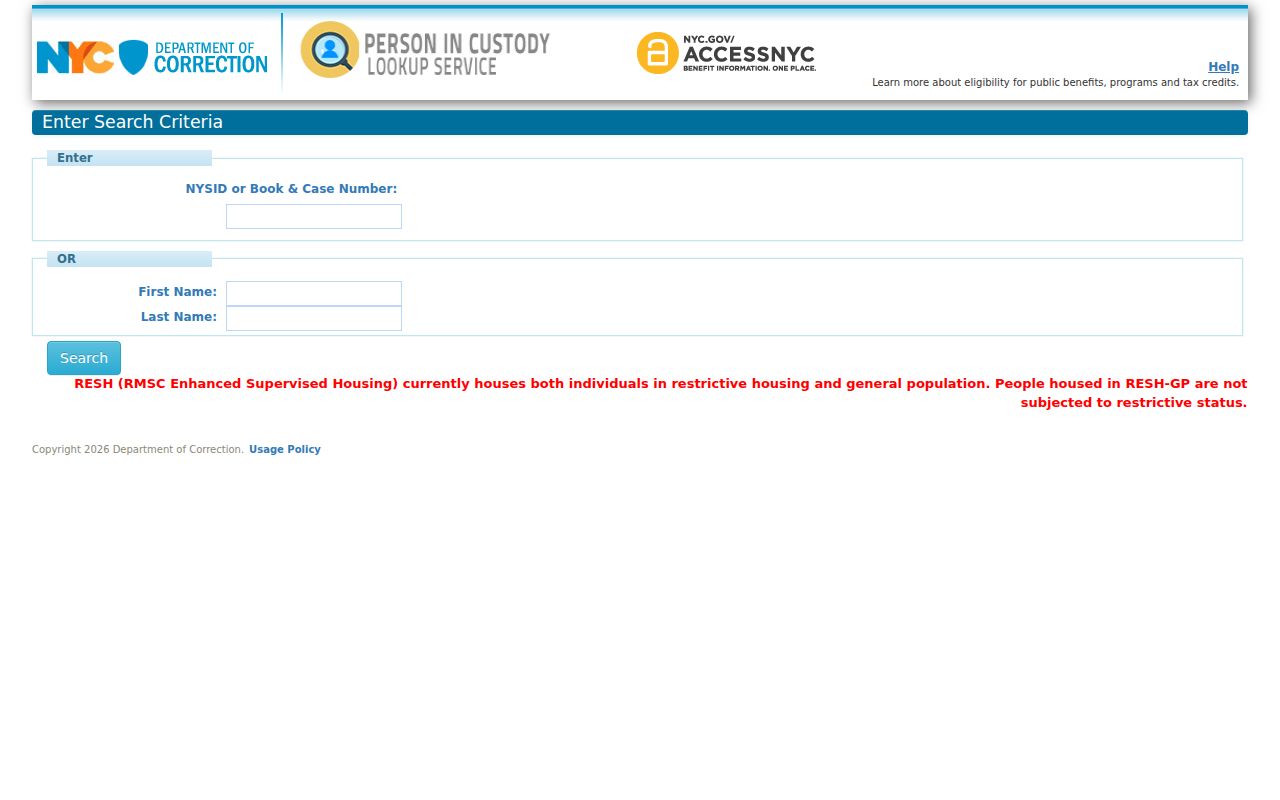
Its citywide scope matters because most people held after a New York County arrest are housed on Rikers Island in Queens, while secure Bellevue units are in Manhattan. Custody location and arrest county can therefore differ.
Inside a New York County Arrest Record
Police and custody systems capture overlapping but distinct fields. Public production can redact personal identifiers, information about victims or minors, and details whose release could impair an investigation or safety. Booking photographs support identification inside the justice system, but mugshots are not represented as an ordinary public field in the current NYC DOC lookup.
| Arrest identifiers | Arrest number, complaint or incident number, fingerprint transaction, and NYSID linkage when created. |
|---|---|
| Date and place | Arrest date, time, location, and the precinct or command responsible for the event. |
| Agency and officer | Arresting agency and officer information, subject to lawful redaction. |
| Alleged offenses | Arrest-stage allegations and statutory citations, which may differ from charges later filed. |
| Custody identifier | Book and Case number created by NYC DOC only after the person is accepted into continued city custody. |
| Release or bail | Desk appearance, court routing, bail, remand, release, or transfer details where the relevant system records them. |
| Photograph policy | A booking image may exist, but NYC DOC does not present a public mugshot gallery in its ordinary lookup. |
The court docket should be checked before treating an arrest charge as the case charge. Prosecutor review may narrow, replace, or decline the original allegation.
Request New York County Arrest Reports
NYPD routes arrest reports, collision reports, aided reports, verification letters, and Certificates of Conduct through different workflows. The routine records page is the first stop for a listed product. Certificates of Conduct require an appointment and an in-person appearance at One Police Plaza. For other agency records, NYC OpenRecords is the formal New York Freedom of Information Law route.
A strong FOIL request names the Police Department, gives the arrest or complaint report number if known, and supplies the precinct, date range, location, and involved person's name. Describe the exact record rather than asking for a broad history. Active investigations, sealed matters, juvenile information, victim details, and safety-sensitive material may be withheld or redacted. NYPD's landing page did not state one universal copy fee, so the live product or agency response controls any charge.
NYPD Record Requests
One Police Plaza
New York, NY 10038
646-610-5000 or 311
Routine products, appointments, and FOIL routing
NYC DOC Records Access
Legal Division, Suite 305
75-20 Astoria Boulevard
East Elmhurst, NY 11370
Weekday inspection or copy appointments, 9 a.m. to 4 p.m.
DOC FOIL requests go through OpenRecords or by mail to its Records Access Officer. Paper copies cost $0.25 per page or actual reproduction cost, and a denial may be appealed within 30 days.
Booking Logs and Recent Arrests
NYPD does not publish a full daily Manhattan booking log like the blotters used by many county sheriffs. Press releases and CompStat reports describe selected events or aggregate crime trends, not a complete person-level roster. That gap makes the current DOC lookup, NYPD records route, and court docket the practical official chain for recent New York County arrest information.
Timing changes what each channel shows. Police may hold a person before arraignment. Prosecutors then decide what charges to file, and the Criminal Court creates a docket. Only continued custody creates a DOC Book and Case entry. Release at arraignment means the arrest may never appear in the DOC system. Absence from that search proves only that the lookup did not return current city custody under the identifiers used.
New York County Arrest Transfers
City and state custody have separate official locators. NYC DOC covers people held in city jail, often while a New York County case is pending. DOCCS covers state prison custody and certain release-history information, subject to statutory omissions. Federal custody uses the Bureau of Prisons system. The correct locator depends on the most recent court and custody event.
The DOCCS Incarcerated Lookup is the state-level source for a transfer beyond city jail.
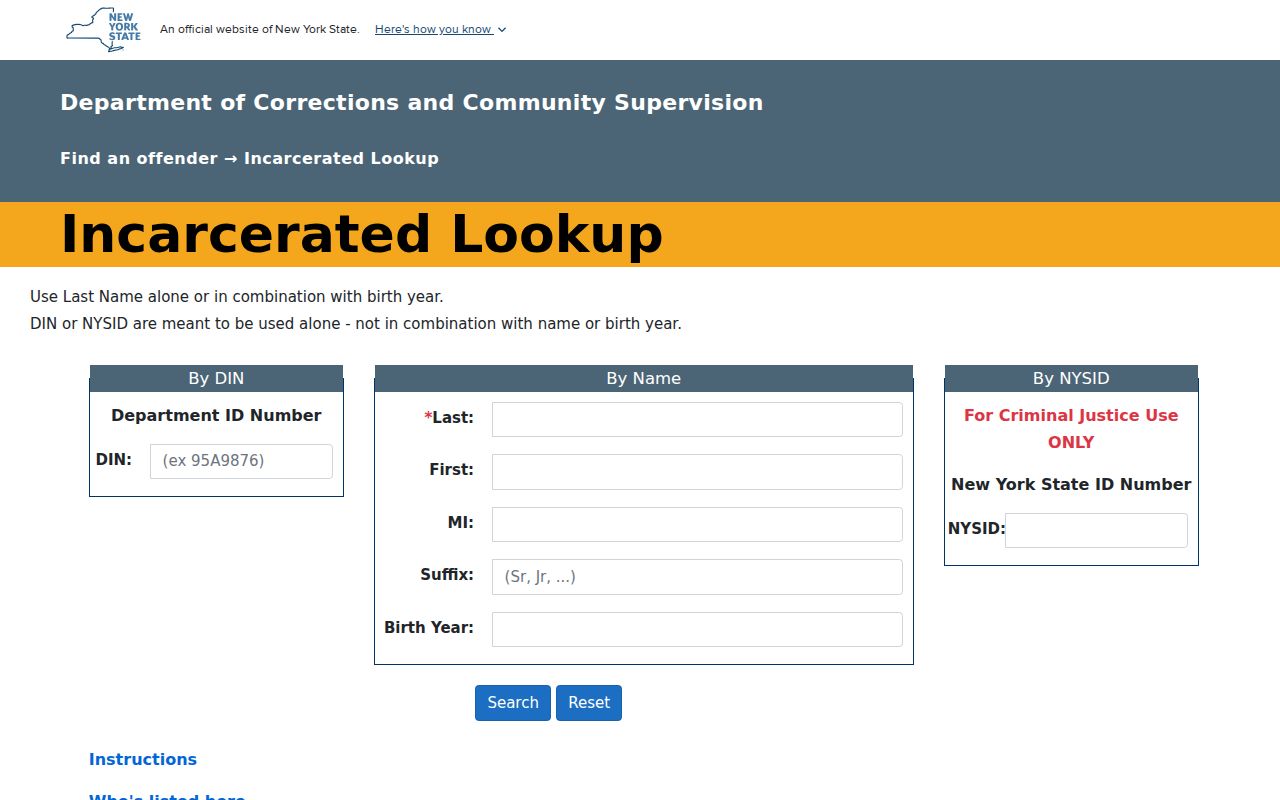
This state search does not replace the NYPD arrest report or New York County court file. It answers where a qualifying person is or was held under DOCCS rules.
New York County Arrest Timeline
A New York County arrest moves through distinct record owners. The arresting officer prepares the complaint and arrest paperwork. Central booking captures identity, fingerprints, and a photograph, then sends fingerprint data toward DCJS. The prosecutor reviews the allegations and drafts the accusatory instrument. At arraignment, the Criminal Court records counsel, release, bail, or remand.
Record flow: Arrest report › fingerprint booking › prosecutor review › Criminal Court arraignment › release or NYC DOC admission › disposition reported to DCJS.
Charges can change at more than one point. An arrest allegation is not the same as the filed accusatory instrument, and neither establishes guilt. For the prosecution record, consult the New York County criminal court case file. If a disposition is missing from your DCJS record, obtain a certificate of disposition from the original court and use the DCJS challenge process.
Arrests Are Not Convictions
An arrest records police action based on alleged conduct. A conviction is a court judgment following a guilty plea or verdict. Between those points, prosecutors may decline or alter charges, a court may dismiss the case, or a trial may end in acquittal. The record holder also changes with the stage.
| Point | Arrest Record | Conviction Record |
|---|---|---|
| Creator | Arresting agency; DOC only if custody continues | The court, then reported to DCJS |
| Meaning | Police made an arrest on an allegation | A court entered guilt by plea or verdict |
| Main source | NYPD request, OpenRecords, or current DOC custody lookup | Original court file, certificate, CHRS, or one's DCJS review |
| Later outcome | Release, no filing, dismissal, acquittal, or prosecution | Sentence, appeal, or qualifying record sealing |
A favorable termination is generally sealed under CPL 160.50, which ends ordinary public access to covered police, prosecutor, court, and DCJS records. Public search gaps can also arise from lawful sealing, not merely from poor matching.
Note: An arrest is not proof of guilt, and many New York County arrests do not result in a conviction.