
Checking Criminal History in New York County
Start with the kind of fact that must be confirmed. A future court appearance belongs in New York eCourts WebCrims. A statewide public history of open and conviction cases belongs in the Office of Court Administration Criminal History Record Search, or CHRS. A certified result comes from the clerk of the court that decided the case. The state repository is available only for a fingerprint-based review of one's own record, not as a public name search.
Names alone can mislead in New York County. Gather a full legal name, date of birth, spelling variants, and any known docket, indictment, arrest, or Book and Case number. Then follow the record rather than assuming one empty result ends the search.
- Use WebCrims for a pending New York County case or future appearance.
- Use CHRS for public statewide open and conviction history tied to an exact name and birth date.
- Contact the original court clerk for the detailed file, archived material, or a certificate of disposition.
- Check the NYC Department of Correction custody lookup only when current city custody is relevant.
- Request police material through the NYPD records channel, and use fingerprint review to inspect one's own official state history.
Note: An empty WebCrims or DOC result does not prove that no arrest, old case, sealed case, or other custody record exists.
Four New York County Record Searches
New York County criminal records divide into four useful lanes. WebCrims is mainly a calendar for pending matters. CHRS is an exact-match public court history. DCJS maintains a fingerprint-linked rap sheet for the subject's own review. NYC DOC holds current city custody data. The right lane depends on whether the goal is to find a date, confirm a public outcome, inspect one's own state record, or locate someone now held by the city.
| Official channel | Best use | Main limit |
|---|---|---|
| WebCrims | Pending case, court part, and next appearance | Not a complete historical rap sheet |
| OCA CHRS | Statewide public open and conviction case search | Exact name and date of birth; not certified |
| DCJS review | One's own fingerprint-linked New York history | Cannot be ordered on another person |
| NYC DOC lookup | Current city custody and Book and Case data | Excludes police, state, and federal custody |
The New York County systems overlap at key points but remain distinct. An NYPD arrest may produce a Criminal Court docket and a DCJS arrest cycle without ever producing a DOC profile if the person is released at arraignment.
New York Official Background Checks
The New York State Division of Criminal Justice Services keeps the central identity-based repository. A person or that person's attorney may request a Personal Record Review. The request uses fingerprints captured through IdentoGO. An unsuppressed response includes linked history that is normally hidden from public systems, while a suppressed response omits those categories. Each choice requires its own submission.
The official DCJS Personal Record Review instructions show how the state distinguishes self-review from a public court search.
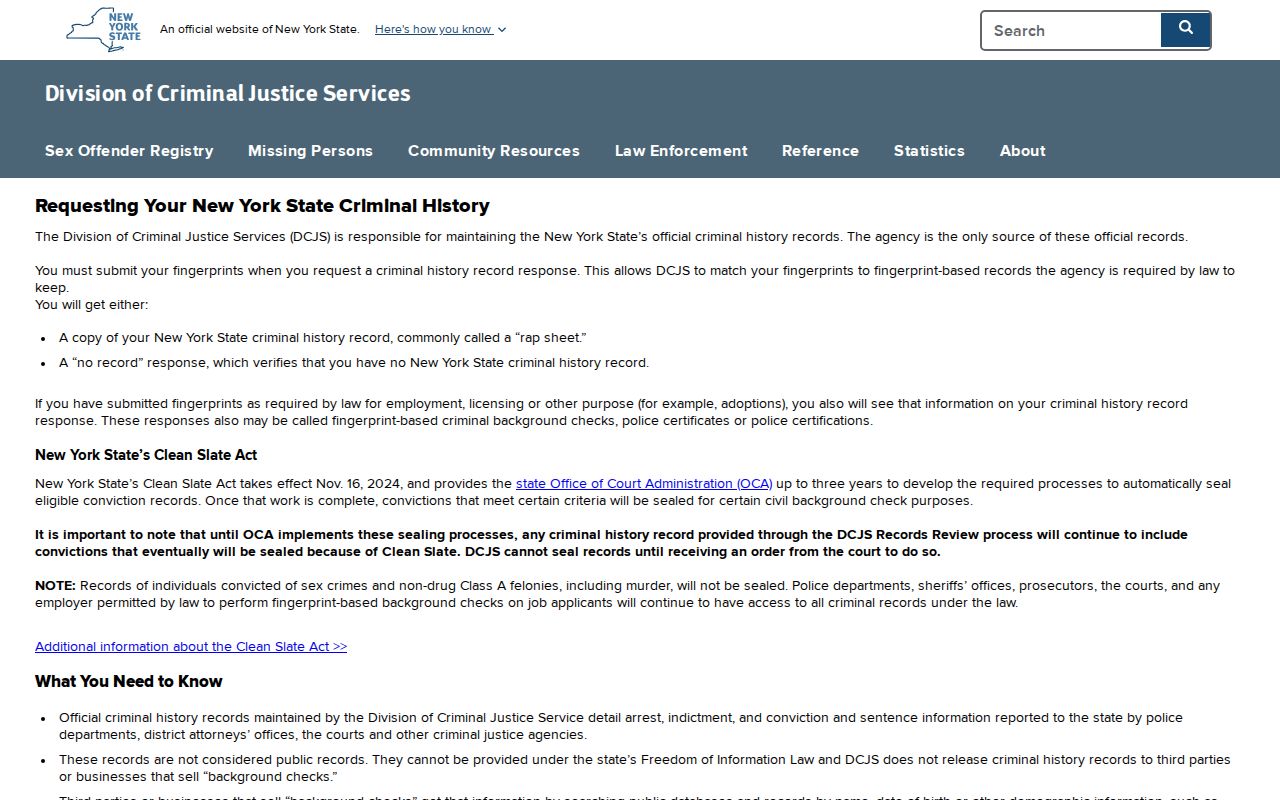
This state process ties the request to fingerprints, which makes it the sound channel for checking whether an arrest cycle or disposition has been matched to the correct person.
New York County requesters use service code 15464Z for a suppressed review and 15465F for an unsuppressed review. Beginning February 2, 2026, the IdentoGO processing fee is $17.50. DCJS says responses are mailed in about three to four weeks, with no pickup option. A fee-waiver packet is available from the Record Review Unit. Public court checks remain separate because CHRS does not establish identity by fingerprint.
New York County CHRS Exact Matches
CHRS costs $95 for each exact full-name and date-of-birth search. An alias, spelling variant, or alternate birth date counts as another paid search. Direct Access works online, while mail requests go to the CHRS Unit at 25 Beaver Street, Room 940, New York, NY 10004. There is no walk-in service at that address. The product reports qualifying public open, pending, and conviction cases from New York criminal courts, but it is not a certified disposition.
The OCA CHRS overview sets out the fee, exact-match rules, and delivery choices.
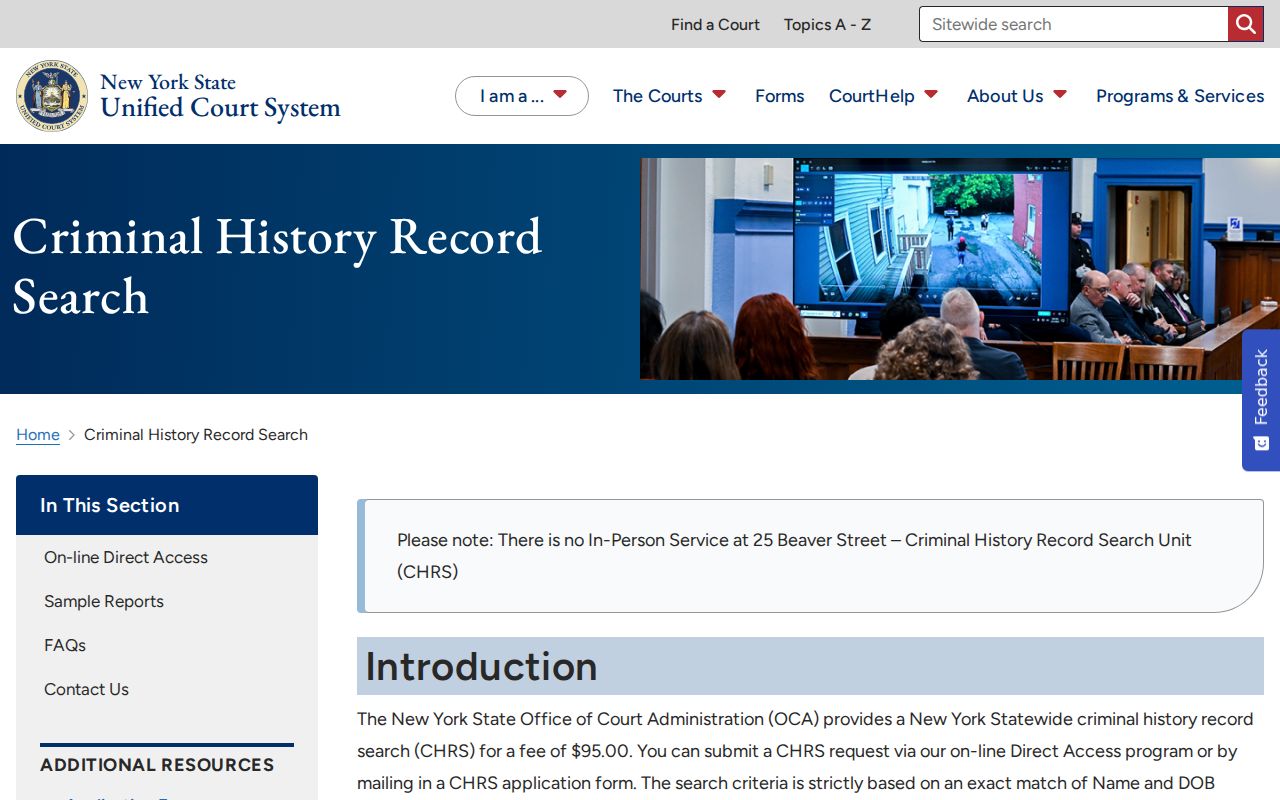
The official screen reinforces a key distinction: CHRS is a court-record product, not the DCJS fingerprint repository and not a certificate from the court of origin.
| CHRS field | Rule | Practical effect |
|---|---|---|
| Full name | Exact spelling | Aliases and variants are separate searches |
| Date of birth | Exact date required | An alternate date costs another $95 |
| Payment | Card online; check or money order by mail | No cash for mailed work |
| Delivery | Email or mail | Mailed results require a self-addressed stamped envelope |
New York County court data generally update about every 24 hours. A no-result online request can return at once, but a batch with any possible record is held for weekday staff review. Sealed cases and other excluded categories will not appear.
Criminal Record Types
Each New York County record answers a different question. The police arrest report records an accusation and enforcement act. The court file shows what prosecutors filed and how the judge resolved it. A DOC entry shows city custody after a remand or an unmet bail condition. A DCJS rap sheet joins fingerprint-backed arrest cycles with reported outcomes. The registry, probation, parole, warrant, and prison systems add narrower layers.
- Police and arrest reports: NYPD records list the event, alleged offense, agency details, and report identifiers, subject to lawful redaction.
- Court case files: Criminal Court dockets and Supreme Court indictment files track filed charges, dates, motions, dispositions, and sentences.
- Custody records: NYC DOC covers current city custody, while DOCCS covers state prison and some release history.
- Warrants: Courts issue them, but New York City has no complete public NYPD warrant-name database.
- Supervision and registry records: Court files may show a sentence, while operational probation and parole files are not public rosters.
For deeper New York County case detail, the New York County criminal court case record follows charges from arraignment through disposition. Arrest questions still require separate police, court, and booking channels.
New York County Records Without Sheriff
Manhattan does not follow the common county model in which a sheriff patrols, books people, runs a jail, and answers arrest-record requests. The NYC Sheriff's Office mainly enforces civil and finance matters. NYPD creates the arrest or incident report. NYC DOC creates a custody record only after a court commits the person. State court clerks keep the criminal dockets. Asking for a New York County sheriff arrest log will therefore send the search down the wrong path.
When a routine New York County NYPD or DOC product does not fit, the NYC OpenRecords portal is the city FOIL fallback. Select the agency, give a clear date range and location, add the complaint, arrest, precinct, or Book and Case number when known, and retain the tracking number. A narrow description helps the agency locate the correct record.
NYPD Record Requests
646-610-5000 or 311
One Police Plaza
New York, NY 10038
NYC DOC Legal Division
75-20 Astoria Boulevard, Suite 305
East Elmhurst, NY 11370
FOIL inspection and copy appointments are offered on weekdays.
DOC paper copies cost $0.25 per page or the actual reproduction cost. NYPD's landing page did not state one universal fee because its record products follow different routes.
Note: FOIL may reach existing agency records, but it does not replace criminal discovery or provide real-time warrant clearance.
Inside a New York County Criminal Record
A record's fields reveal which system produced it. DCJS organizes information by fingerprint identity and arrest cycle. Courts organize it by docket or indictment. DOC uses Book and Case data for custody. Read the source label before treating a charge, status, or release field as a final result.
| Name and identifiers | Legal name, aliases, date of birth, NYSID, FBI number, docket, indictment, or Book and Case number as the source permits. |
|---|---|
| Arrest and booking data | Arrest date, agency, alleged offenses, report number, fingerprint link, and custody routing. |
| Charges and statutes | Filed offense text, Penal Law citation, count status, and felony, misdemeanor, or violation class. |
| Disposition | Plea, verdict, dismissal, or other result reported for the charge or case. |
| Sentence | Jail, prison, probation, fine, surcharge, or release terms when entered in the public court record. |
| Custody or supervision | Facility, admission, release, or community-supervision status where the proper agency makes it public. |
A New York County Class B felony, for example, can carry a general maximum framework of 25 years, while a Class A misdemeanor has a general jail maximum of 364 days. Those ceilings are not a sentence prediction. Offense-specific, violent-felony, predicate, drug, sex-offense, and supervision rules can change the result. The disposition and sentence fields control.
- Disposition
- The result or status that resolves a charge or case.
- Indictment number
- The Supreme Court identifier for a felony case after grand-jury action.
- Court part
- The courtroom or calendar unit shown on WebCrims and courthouse lists.
- Certificate of disposition
- The original court's certified statement of outcome, unlike a CHRS report.
New York County Custody Record Choices
A Manhattan arrest can lead to a Queens custody record. Most people kept in city jail custody are housed on Rikers Island, while Bellevue has secure hospital units in Manhattan. The closed Manhattan Detention Complex does not supply a live local jail roster. That geography is why a search limited to New York County facilities can miss a current NYC DOC record.
If a New York County DOC search shows no result, consider timing and jurisdiction. The person may still be in police custody, may have been released, or may have moved to state or federal custody. The DOCCS Incarcerated Lookup covers state custody and some release history. Federal custody uses the Bureau of Prisons locator. Current DOC visiting days are generally Wednesday, Thursday, Saturday, and Sunday, with Friday televisits, but readers should confirm the current schedule and last-name rules before a trip.
| Custody stage | Record holder | Useful identifier |
|---|---|---|
| Very recent police hold | NYPD or arresting agency | Arrest or complaint number |
| Current city jail | NYC DOC | Name, NYSID, or Book and Case number |
| State prison | New York State DOCCS | Name or state identifier |
| Federal prison | Federal Bureau of Prisons | Name or federal register number |
Note: A DOC profile is a custody record, not a finding of guilt and not a copy of the NYPD arrest narrative.
New York County Warrant Records
New York City does not publish a complete NYPD warrant-name database. WebCrims may show a pending case or appearance tied to a bench warrant, and the original court clerk can confirm public docket status. Sealed warrants, sealed indictments, juvenile matters, and active law-enforcement data remain outside public search. An empty portal result is not proof that no New York County warrant exists.
A bench warrant usually follows a missed appearance or failure to comply, while an arrest warrant authorizes an arrest on a criminal accusation. Someone resolving their own warrant should use the court shown on existing papers and seek legal advice before appearing. FOIL is not a real-time clearance tool, and a court order recalling a warrant may take time to reach every database.
Public Access Laws in New York
New York County criminal records are not open under one blanket rule. Agency records pass through FOIL and its exemptions. Court clerks have a separate duty to search and certify court files. Sealing statutes remove qualifying cases from ordinary public view, and registry law controls which risk-level information DCJS may publish. Grand-jury material, youthful-offender records, protected victim data, and active-investigation details can remain closed or redacted.
Key New York access laws:
Public Officers Law Article 6 creates the FOIL process for reasonably described agency records and appeals.
Judiciary Law §255 directs clerks to search, certify, or return court records subject to lawful limits and fees.
CPL 160.50 seals official records after qualifying favorable terminations.
CPL 160.59 permits court-ordered sealing of a limited number of eligible convictions.
CPL 160.57 establishes the Clean Slate automatic-sealing system.
Correction Law Article 6-C governs registration, risk levels, and public registry disclosure.
A New York County denial under FOIL should state the appeal path. Court certificates, however, must come from the court of origin. The two access routes should not be treated as interchangeable.
New York County Criminal Record Clerks
The split between 100 and 111 Centre Street is one of Manhattan's most useful record-search facts. Criminal Court at 100 Centre handles arraignments, misdemeanors, violations, and felony matters before indictment. Supreme Court, Criminal Term, hears indicted felonies in both buildings. A felony may therefore begin under a Criminal Court docket and later continue under a Supreme Court indictment number.
The official Supreme Court Criminal Term information identifies the Central Clerk at 100 Centre Street, Room 1000, telephone 646-386-4000. That office keeps finished Supreme Court files from 2014 forward and provides lookups, dispositions, filings, certifications, and payment services. The Ancillary Clerk is at 111 Centre Street, Room 927, telephone 646-386-4300, with lookup, filing, bail-help, and certification functions.
Supreme Court Central Clerk
100 Centre Street, Room 1000
New York, NY 10013
646-386-4000
The Ancillary Clerk at 111 Centre Street, Room 927, can be reached at 646-386-4300. Both Supreme Court locations operate from 9:00 a.m. to 4:30 p.m. Older finished files need archive routing, so a call before travel can prevent a wasted visit. Daily alphabetical defendant lists in the 100 Centre lobby and part calendars remain useful for same-day appearances.
Sealed, Expunged, and Restricted Records
New York County follows the state's record-sealing system rather than a broad process that destroys adult criminal files. CPL 160.50 covers many dismissals, acquittals, and other favorable terminations. CPL 160.55 restricts specified violation and infraction outcomes. CPL 160.59 lets a person ask the sentencing court to seal up to two eligible convictions, no more than one felony, after the law's waiting period and other conditions.
Youthful-offender adjudications are confidential under CPL article 720. Some justice agencies retain access for defined purposes even when ordinary public search results no longer display a matter. That is why a sealed case can appear on an unsuppressed personal DCJS review while remaining absent from CHRS or WebCrims.
For application sealing, obtain an exact certificate of disposition and review one's DCJS record before filing in the sentencing court. Research did not locate a stated filing fee for a CPL 160.59 motion on the official pages reviewed. Ask the clerk about copy or certification costs instead of assuming a fee.
Note: Sealing can restrict public access, but it does not always erase every record from every authorized government use.
Correcting New York County Criminal Records
A missing New York County court outcome on a rap sheet is best found through personal record review. Identify the arrest cycle or case entry, obtain a certified disposition from the original court, and submit the supporting proof through the DCJS challenge process. DCJS lists RecordReview@dcjs.ny.gov and telephone numbers 518-457-9847 and 518-485-7675 for Record Review questions on weekdays from 8:00 a.m. to 4:00 p.m., excluding holidays.
The official IdentoGO enrollment service begins with the DCJS service code and then presents identity-document and appointment choices.
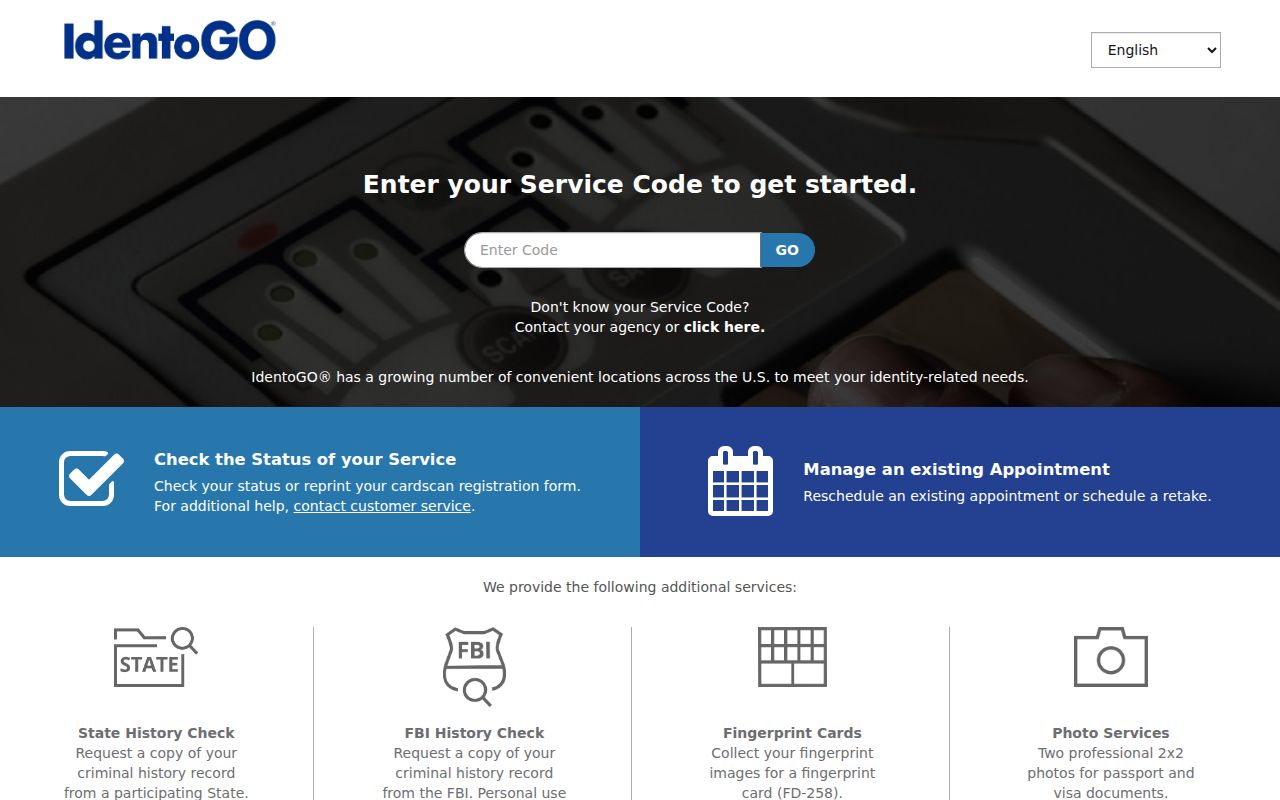
The enrollment screen is the fingerprint-capture step, not a public search for another person's New York County criminal record.
Manhattan enrollment locations and hours can change after service-code entry, so no fixed storefront should be assumed. Bring an accepted identity document. When the issue is a wrong court disposition rather than an identity mismatch, the certified court record supplies the key proof.
New York County Clean Slate Timeline
New York's Clean Slate law took effect in 2024, but the court system has through November 16, 2027 to build and complete the matching and sealing process. Under CPL 160.57, eligible misdemeanor dockets generally reach the waiting point three years after sentence or release, whichever is later. Eligible felony dockets generally use an eight-year period.
Automatic sealing does not apply while a person has a pending misdemeanor or felony or remains on probation, parole, or post-release supervision. A new conviction restarts the relevant clock. Sex crimes and non-drug Class A felonies are excluded. The court system also expects to make a manual review form available by the implementation deadline.
Clean Slate affects ordinary New York County public display, but it does not turn CHRS, WebCrims, and DCJS into the same database. After an expected seal, check the ordinary court result and one's fingerprint review. If the disposition is missing, return to the original clerk for a certified copy and use the DCJS correction route.
New York County Criminal Records by City
New York City is the only incorporated city represented in New York County. Manhattan is a borough of that city and is coterminous with the county for this project, so neighborhoods such as Harlem and Chelsea are not separate city record systems. NYPD, NYC DOC, state courts, DCJS, DOCCS, and federal courts still keep different layers despite the single-city geography.
New York City Criminal Records
New York County's 2025 population estimate is 1,664,862. Manhattan police reports are centralized through NYPD, and state courts handle criminal cases.
The city profile covers Manhattan precinct records, OpenRecords, CompStat, the citywide custody system, and the unusual split between city agencies and state court clerks.
New York County Supervision Records
A public court file can show that a judge imposed probation, prison, or post-release supervision. It does not make the day-to-day supervision file public. NYC Department of Probation handles local adult and juvenile probation. DOCCS Community Supervision handles parole and post-release supervision, while the New York State Board of Parole makes discretionary release decisions.
Manhattan Adult Probation is at 100 Centre Street, 10th Floor, Suite 1037, New York, NY 10013. Its investigation front desk uses 212-590-2712, 212-590-2710, 212-590-2792, and 212-590-2705. Harlem NeON is at 127 West 127th Street, 2nd Floor, Room 204, New York, NY 10027, telephone 646-769-2715. Both offices list weekday hours of 8:30 a.m. to 5:30 p.m.
Use the New York County certificate of disposition to verify a sentence. Contact Probation only for legitimate case-specific routing, and use DOCCS channels for parole decisions or state supervision. Operational notes, officer assignments, and protected personal details are not a general public roster.